
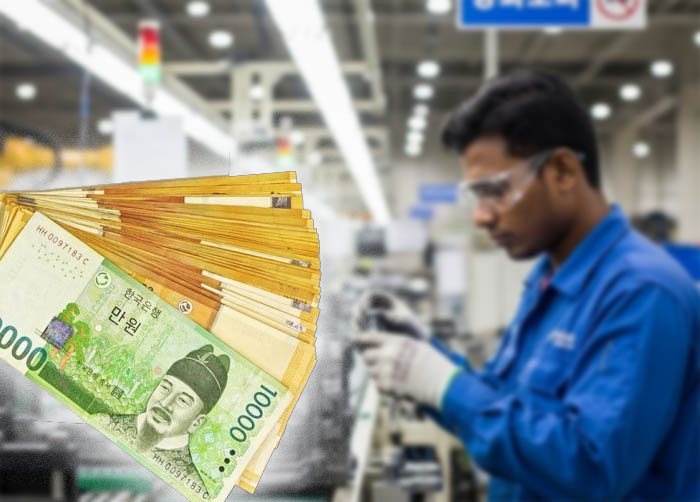
Average Overtime Income in Korean Manufacturing
If you’re thinking about working in manufacturing in Korea — whether temporarily or as part of a longer-term plan — overtime income can make a real difference to your monthly take-home pay. In many factories here, overtime isn’t just occasional; it’s built into the rhythm of production during peak seasons. From a Korean local’s point of view, let’s break down how much overtime work in manufacturing can realistically add to your income and what that means in everyday terms.
Why Overtime Matters in Korean Manufacturing
Manufacturing in Korea often runs on multi-shift schedules, and demand fluctuates with orders, export cycles, and seasonal peaks. That means regular hours don’t always cover the full workload. Overtime becomes a key income booster because:
- Base wages in manufacturing are structured around a standard 40-hour workweek.
- Overtime pay is legally set at higher rates than base pay.
- Workers who can and want to do extra hours often earn significantly more than their base salary.
For many blue-collar workers, overtime isn’t an occasional bonus — it’s an expected part of monthly earnings.
How Overtime Pay Is Calculated
Korean labor law mandates that overtime pay must be higher than the regular hourly wage. As a general rule, overtime is paid at 1.5 times (50% more) the regular rate. If you work at night, on weekends, or on holidays, those rates can go higher (often 1.5 to 2 times regular pay, depending on company and contract).
Example:
- Base hourly wage: 12,000 KRW (about 9.20 USD)
- Overtime rate (1.5×): 18,000 KRW (about 13.80 USD)
So each hour of overtime pays significantly more than a regular hour.
Typical Overtime Scenarios and Income Boosts
Let’s look at how overtime adds up in a typical month:
Standard Monthly Work (No Overtime)
- 40 hours per week × 4.3 weeks ≈ 172 hours
- 12,000 KRW × 172 hours = 2,064,000 KRW (about 1,580 USD)
Moderate Overtime (10 hours/week)
- 172 regular hours as above
- 10 overtime hours/week × 4.3 ≈ 43 hours of overtime
- Overtime pay: 18,000 KRW × 43 hours = 774,000 KRW (about 590 USD)
- Combined income: 2,064,000 + 774,000 = 2,838,000 KRW (about 2,170 USD)
Heavy Overtime (20 hours/week)
- Regular earnings: 2,064,000 KRW
- Overtime hours ≈ 86 × 18,000 KRW = 1,548,000 KRW (about 1,180 USD)
- Combined income: 3,612,000 KRW (about 2,760 USD)
In practice, many workers wind up somewhere between those examples depending on factory schedules and seasonal demands.
Monthly Comparison: With and Without Overtime
Here’s a simplified comparison of monthly income based on overtime:
Income Type | KRW per Month | USD Equivalent
Regular hours only | 2,064,000 KRW | 1,580 USD
- Moderate overtime (10 hrs/wk) | 2,838,000 KRW | 2,170 USD
- Heavy overtime (20 hrs/wk) | 3,612,000 KRW | 2,760 USD
The takeaway? Overtime can boost your income by 30–75% or more. That’s why many factory workers in Korea structure their lives around overtime availability.
Real-World Variability
Of course, actual results vary by factory and region:
Factory Type
- Electronics assembly vs. heavy machinery vs. food processing — each has different overtime patterns.
- Some sectors see weekly overtime, others only seasonally.
Shift Scheduling
- Single shift factories tend to offer more overtime than multi-shift ones, where night and weekend shifts may already be built into base pay.
Company Policies
- Some companies cap overtime or negotiate schedules with unions. Others encourage overtime to meet order deadlines.
Your own willingness and availability to work extra hours also matters — some workers prefer a steadier schedule with less overtime.
Taxes, Deductions, and Take-Home Pay
Keep in mind that overtime earnings are taxable income. Korea’s income tax and social insurance contributions apply to your total monthly earnings — base plus overtime. Still, even after deductions, the overtime bump usually remains significant.
Example:
If taxes and insurance reduce your gross by roughly 10–12%, you still walk away with a meaningful higher net salary thanks to overtime.
Daily Life Impact of Overtime Earnings
In many industrial regions, overtime income affects major life decisions:
Housing
- Higher monthly earnings make it easier to rent decent apartments near factories.
Transportation
- Workers often use a portion of overtime earnings for transport passes, especially in areas with limited transit.
Family Support and Remittances
- For foreign workers who support families abroad, overtime income makes sending money home more manageable.
Savings and Future Planning
- Many workers use overtime income to save for bigger goals — education, property down payments, or business ventures.
Why Overtime Is a Double-Edged Sword
While the extra cash is attractive, it’s worth noting:
Work-Life Balance
- Heavy overtime can be tiring and affect health or family time.
Labor Standards
- Korea has laws limiting overtime and mandating rest, but enforcement varies by workplace.
Negotiation and Rights
- Knowing your rights around overtime rates, breaks, and limits can improve your work experience as much as the income itself.
Local labor offices and worker unions can offer guidance if you ever feel your rights aren’t respected.
Final Thoughts
Overtime is a big factor in manufacturing income in Korea. While base wages give stability, overtime is often what turns a modest salary into something considerably stronger — sometimes boosting take-home pay by hundreds of thousands of won per month (or several hundred dollars). If you’re planning to work in manufacturing here, understanding how overtime is calculated and what it realistically adds to your monthly income is essential. It’s not just about hourly rates — it’s about how those hours add up in your life.
For many workers, overtime isn’t just extra cash: it’s a pathway to savings, stability, and a better quality of life.
Beyond the Oppa: The Role of Culture in Korean Men’s Dating Style