
Specific Ways for Foreigners to Master Hangul Quickly
You’re ready to learn Korean, and your first (and best) step is conquering the alphabet, Hangul (한글). Designed in the 15th century to be easy to learn, Hangul is often hailed as one of the most efficient writing systems in the world. Yet, for a beginner, it still looks like a series of circles, lines, and squares playing tic-tac-toe.
Fear not! As a local, I can tell you that the secret to rapid Hangul mastery isn’t endless memorization; it’s understanding the logic, shapes, and precise techniques that unlock its genius. Forget tedious flashcards—here are the specific, actionable methods to master Hangul quickly and effectively.
1. The Three-Day Logic Hack: Focus on the Mouth
Hangul wasn’t designed randomly; the shapes mimic the position of the mouth and tongue when making the sound.
The Rule: Dedicate 72 hours to learning the consonants (자음) and vowels (모음) based on their visual logic, not just rote memorization.
Actionable Tip: Focus on the “core five” consonants (ㄱ, ㄴ, ㄷ, ㄹ, ㅁ) which represent the shape of your articulators (tongue, teeth, mouth). For example, the square (ㅁ) represents the shape of your mouth when you say ‘m’. The flat line (ㄴ) represents the tongue touching the upper palate when saying ‘n’.
Why it Works: Understanding the logic helps you recall the sounds instantly, making the learning process much faster than just looking at Romanized equivalents.
2. The Block Assembly Game (Syllable Structure)
Once you know the letters, you need to understand how they stack into a syllable block. This is where Hangul mastery truly begins.
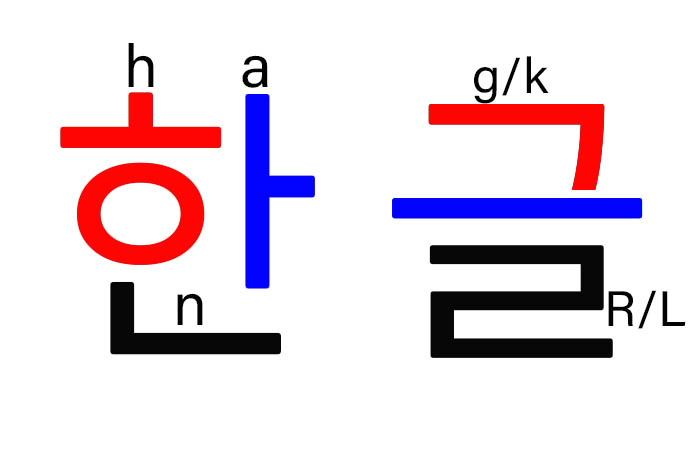
The Rule: Every Korean syllable block must start with a consonant and contain a vowel. It must be a perfect square or rectangle (e.g., 한, 글).
Actionable Tip: Think of the vowels as having specific positions:
Horizontal Vowels (like ㅜ, ㅡ): The consonant goes above (e.g., 무).
Vertical Vowels (like ㅏ, ㅓ): The consonant goes to the left (e.g., 가).
The Zero Consonant (Silent Circle): When a syllable starts with a vowel sound (like ‘ah’ or ‘oh’), you must use the circle (ㅇ) as a silent placeholder (e.g., 아, 오). This is a mandatory structural rule.
3. The Immersive Labeling Technique
You need to train your brain to see the shapes of Hangul everywhere you look.
The Rule: Stop relying on Romanization.
Actionable Tip: Find a sheet of simple Hangul syllables (e.g., 가, 나, 다, 라) and stick them on household objects. Label your 커피 (coffee), your 문 (door), and your 컴퓨터 (computer). This forces your brain to constantly process the shapes and associate them with familiar sounds and objects.
Why it Works: It uses context and repetition to internalize the shapes in real-world settings, making the learning passive and fun.
4. The K-Pop/K-Drama Lyric Challenge
Once you can sound out basic blocks, jump into the culture you love!
The Rule: Use K-Pop lyrics or simple K-Drama dialogue transcripts.
Actionable Tip: Find a K-Pop ballad or a slightly slower song. Print the lyrics in Hangul and try to read it aloud while the song plays. Don’t worry about the meaning yet—just focus on matching the sound you hear to the shapes you are reading.
Why it Works: It reinforces the rhythm and tone of the language while validating your Hangul reading skills with something you already enjoy.
Mastering Hangul is your most important step. It’s the key that unlocks the rest of the Korean language, and with these specific techniques, you can do it much faster than you think!