
Do Korean Manufacturers Provide Free Meals?
This is one of the most common questions I hear from foreigners who are curious about working in Korean factories. And honestly, I understand why. Food costs add up quickly, especially if you are new to Korea and still figuring out where and how to eat affordably.
So let me answer this clearly from a local Korean perspective.
Yes, many Korean manufacturers do provide free meals.
But as with most things in Korea, the details matter.
Why Free Meals Are So Common in Korean Factories
In Korea, factory work has traditionally involved long hours, shift work, and physically demanding tasks. Providing meals is not just seen as a benefit, but almost as a basic courtesy in manufacturing environments.
From a Korean mindset, a worker who is tired and hungry cannot work safely or efficiently. That is why meals are often built into the daily work structure rather than treated as an optional perk.
Especially in manufacturing, food is considered part of “taking care of employees,” not a luxury.
What Kind of Meals Are Usually Provided
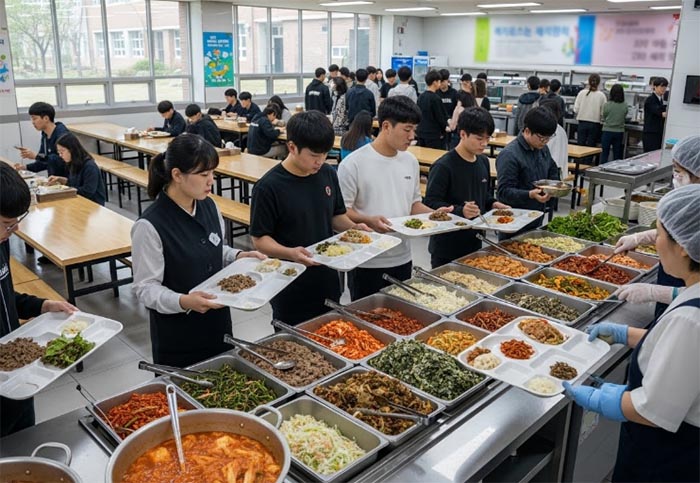
Most manufacturers that offer free meals do so through an in-house cafeteria or a contracted food service company.
A typical factory meal includes:
- Rice
- Soup or stew
- Two to three side dishes
- Sometimes meat or fish
It is simple, filling, and very Korean. You will not see fancy restaurant food, but you will almost always leave full.
For foreigners, the food can be surprisingly healthy compared to fast food or convenience store meals. Many workers actually rely on factory meals as their main balanced meal of the day.
How Many Meals Per Day Are Covered
This depends on the work schedule.
Day shift workers usually receive one free meal, lunch.
Shift workers or overtime workers may receive:
- Lunch
- Dinner
- Late-night meal if working overnight
At larger manufacturers, it is not unusual for workers doing long overtime to receive two or even three free meals in one day.
Smaller factories may limit free meals to lunch only, but dinner is often provided if overtime is required.
Big Manufacturers vs Small Manufacturers
Here is where differences become noticeable.
Large manufacturers usually have:
- Full cafeteria facilities
- Regular menus that rotate daily
- Free meals without any deductions
- Snacks or drinks during long shifts
Small manufacturers may:
- Provide one free lunch
- Offer meal allowances instead of cafeteria food
- Order lunch boxes from nearby restaurants
In some small factories, meals are technically free but deducted indirectly through lower allowances. This is not illegal, just a different structure.
From a worker’s point of view, big manufacturers are more consistent and transparent about meal benefits.
Are Meals Really Free or Deducted from Salary
This is a very important question.
In most Korean manufacturing jobs, meals are genuinely free and not deducted from your salary. They are classified as employee welfare benefits.
However, there are exceptions:
- Some companies include meals as part of a total compensation package
- Others provide meal cards or allowances instead of cafeteria food
A good rule of thumb is to ask directly during the job offer stage. In Korea, this is a normal and expected question.
What If You Have Dietary Restrictions
This is one area where foreign workers sometimes struggle.
Factory meals are usually designed for Korean tastes, meaning:
- Meat is common
- Vegetarian options are limited
- Halal or allergy-specific meals are rare
Some larger manufacturers are becoming more flexible, but in many cases, workers with dietary restrictions bring their own food even if meals are provided.
Still, having access to free rice, soup, and side dishes can help reduce food costs significantly.
Why This Benefit Matters More Than You Think
From a local perspective, free meals are not just about food. They affect:
- Monthly living expenses
- Energy levels during long shifts
- Workplace morale
- Social bonding with coworkers
Many foreign workers are surprised to realize that free meals can save hundreds of dollars per month, especially if two meals a day are covered.
In industrial cities where dining options are limited, factory meals also provide convenience and structure.
Real-Life Worker Experiences
I often hear comments like:
“At first, I did not care about the meals, but after a month, I realized how much money I was saving.”
Another common reaction:
“The food was basic, but after a long shift, it was exactly what I needed.”
These reactions reflect how deeply meals are integrated into factory life in Korea.
So, Should You Expect Free Meals in Korean Manufacturing Jobs
If you are considering factory work in Korea, you should expect at least one free meal per working day, especially in manufacturing roles.
While not every factory operates the same way, free meals are still one of the most widespread and practical benefits in the Korean manufacturing sector.
It is one of those cultural details that does not always appear in job ads, but makes a big difference once you start working.
The K-Drama Effect: How K-Dramas Influence Global Dating Standards