
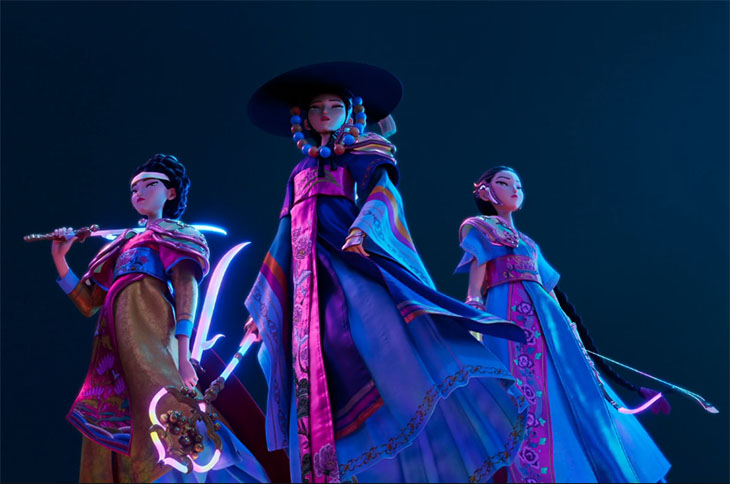
Hallyu(한류) Before and After K-Pop: Demon Hunters: The Beginning of a New Phase
It’s no exaggeration to say that the Korean Wave can now be divided into two eras: before K-Pop: Demon Hunters and after it. With this film, Hallyu didn’t simply expand. It evolved into something more global, more immersive, and more structurally powerful than ever before.
For years, Korean dramas and films have enjoyed immense popularity overseas. Thanks to exports and streaming platforms, K-content steadily built a loyal global audience. However, most K-dramas and films tended to show only fragments of Korea—specific time periods, emotional moments, or isolated settings. They invited viewers to focus on the story itself rather than the country behind it.
As a result, even though countless beautiful locations and landmarks appeared on screen, they rarely translated into a strong, unified image of Korea as a place pe
K-Pop: Demon Hunters changed that completely.
How an Animated Film Captured an Entire Country
What makes K-Pop: Demon Hunters remarkable is its ability to compress and represent Korea as a whole. And the most surprising part is that it achieved this not through live-action, but through animation.
Despite being animated, the film left an incredibly vivid and lasting impression of Korea on global audiences. The proof is already visible. Since the film’s release, the number of foreign tourists visiting Korea has surged noticeably. And based on current trends, that growth shows no sign of slowing down.
Seoul, in particular, is no longer a city experienced mainly by Koreans with occasional foreign visitors. It has become a truly global city—one of the most familiar, approachable, and desirable destinations for travelers worldwide.
A Turning Point for Korea’s Global Standing
From this point forward, Korea’s cultural standing will be different. K-Pop: Demon Hunters opened a new chapter in which Korean content doesn’t just participate in global pop culture, but actively leads it.
The film continues to break records and write new commercial and cultural milestones even now. More importantly, it functions as both a catalyst and a bridge—connecting Korea’s existing influence to a much larger, mainstream global audience.
What makes this moment especially meaningful for Koreans is the film’s production background. K-Pop: Demon Hunters was created with American capital by Sony Pictures Animation, and the majority of the creative team consisted of second-generation Korean Americans. While a small number of Koreans participated, the core of the production was driven by diaspora creators rather than Korea itself.
Ironically, Korea had no direct involvement in the making of the film—and yet became its greatest beneficiary.
There’s a Korean proverb that says, “Watch the ritual and eat the rice cake.” In simple terms, Korea got to enjoy the rewards without bearing the cost. Tourism revenue surged, global visibility skyrocketed, and Korea’s cultural brand strengthened dramatically.
Beyond Tourism: A Cultural Ripple Effect
What’s striking is that this impact doesn’t appear to be temporary. Experts predict that tourism revenue alone could reach tens of trillions of won annually. In other words, Korea has entered a period of extraordinary cultural fortune.
But the deeper effect goes beyond money.
Director Maggie Kang said in an interview that her goal was to make the world fall deeply in love with K-pop—and at the same time, naturally expose audiences to the Korean language. That vision translated into reality with stunning accuracy.
The OST, built around K-pop, swept global charts and immersed international audiences in Korean culture. Just as importantly, Korean language became a key element of the film’s appeal.
Korean Language as a Global Hook, Not a Barrier
Traditionally, K-pop songs inserted English phrases as highlights. K-Pop: Demon Hunters reversed that formula. The songs are primarily in English, but feature Korean lyrics as crucial focal points.
This was a calculated and brilliant decision. Had the songs been entirely in Korean, they may not have spread as widely, no matter how good they were. By structuring the music this way, Maggie Kang ensured global sing-along potential while still requiring listeners to engage with Korean pronunciation and meaning.
The result is clear. Across the world, people are covering the OST—and accuracy in Korean pronunciation has become the most important measure of skill.
The track Soda Pop stands out in particular. It includes a relatively long Korean section with higher linguistic difficulty, forcing singers to practice Korean pronunciation to complete the song properly. In effect, the OST turned language learning into a global challenge.
Searches for Korean lyrics surged worldwide as fans tried to understand and master the words. Without explicitly asking audiences to study Korean, the film made them want to.
Korean Language Woven Naturally into the Film
Beyond music, Korean language appears throughout the film without explanation or translation. Although the movie is primarily in English, Korean words are used openly and intuitively in dialogue and visuals.
Terms like honmun, gwi-ma, maknae, ramyeon, gimbap, hoobae, saja, bipa, and even casual phrases such as “uri mannallae” appear naturally. Signboards are written in Korean, characters address each other using Korean honorifics, and even playful visual details—like changing the Chinese character on Shin Ramyun from “spicy” to “ghost”—reinforce linguistic fa
To fully understand the dialogue or sing the songs properly, viewers are encouraged to look up meanings and pronunciation on their own. This subtle “homework” worked. Global searches related to Korean words and lyrics spiked dramatically after the film’s release.
A Culture Powered by Rhythm and Collective Energy
Korea has always been a nation driven by heung—a deep sense of rhythm, emotion, and collective energy. Historically, Koreans sang together in moments of joy and sorrow alike. From Arirang to protest songs during the democratization movement, and even candlelight vigils accompanied by music, singing has always been central to Korean identity.
K-pop is the modern expression of that spirit, and K-Pop: Demon Hunters distilled it into a global experience.
Korea Is No Longer a Stopover, It’s a Destination
Korea is no longer a place where Koreans live and foreigners occasionally visit. With a population of around 50 million and over 10 million annual visitors, the country has already transformed into a major global destination.
After K-Pop: Demon Hunters, that number is expected to rise sharply. Conservative estimates suggest that by 2026, foreign visitors could reach 15 to 20 million annually.
Locations featured in the film, such as Naksan Park—where Lumi and Jinwoo’s date scene takes place—have already become must-visit landmarks for international travelers.
In Europe and the United States, direct flights to Incheon for late summer and fall are reportedly sold out. Visiting Korea has become more than travel. It’s become a global trend.
K-Pop: Demon Hunters didn’t just entertain the world. It reshaped how the world sees Korea. And that shift feels permanent.