
Helping Your Child Learn Korean as a Second Language
Raising a child in Korea is a wonderful experience — but if your child’s first language isn’t Korean, you’ll quickly notice that language skills affect everything: friendships, school confidence, and how your child feels about living here. As a Korean woman who has watched many multicultural families navigate this journey, I want to share practical, effective advice for helping your child learn Korean as a second language — without stress, without pressure, and with plenty of real-life insights.
Why Korean Matters More Than You Think
Korean isn’t just the language of school. It’s the language of playtime, group activities, cafeteria chatter, and social belonging. Without practical Korean skills, a child may know academic concepts but struggle socially or emotionally.
Many parents tell me they thought English fluency would help first, only to discover that Korean confidence affects every part of daily life here. The good news? With the right approach, children are incredibly adaptable.
Start With What Interests Your Child
One of the best ways to get your child excited about Korean is to connect learning with interest, not obligation.
If your child loves:
- Cartoons — let them watch Korean cartoons
- Games — find simple Korean instructions or apps
- Books — choose picture books in Korean
Interest-driven learning makes the language meaningful, not just academic.
Everyday Conversations Are Language Gold
Children learn language fastest in real situations. Instead of “study time,” try “talk time.” Use simple phrases throughout the day:
- “What time is it?”
- “Let’s wash our hands.”
- “Who wants snacks?”
These routine phrases help vocabulary stick because they are useful — not abstract.
Korean Through Play, Not Just Pages
Language learning should be fun. Korean children pick up phrases through games like:
- Red Light, Green Light (무궁화 꽃이 피었습니다)
- Simon Says in Korean
- Simple role-playing (shopping, school, family)
Play doesn’t feel like study, but it teaches listening, speaking, and cultural expression all at once.
School Language Support Is a Real Resource
Many Korean schools offer language support for non-native speakers. Don’t wait for teachers to come to you. Ask about:
- After-school Korean classes
- One-on-one language support
- Buddy systems with Korean students
Schools want your child to succeed, and most programs are ready to help — once you ask.
Encourage Reading Together
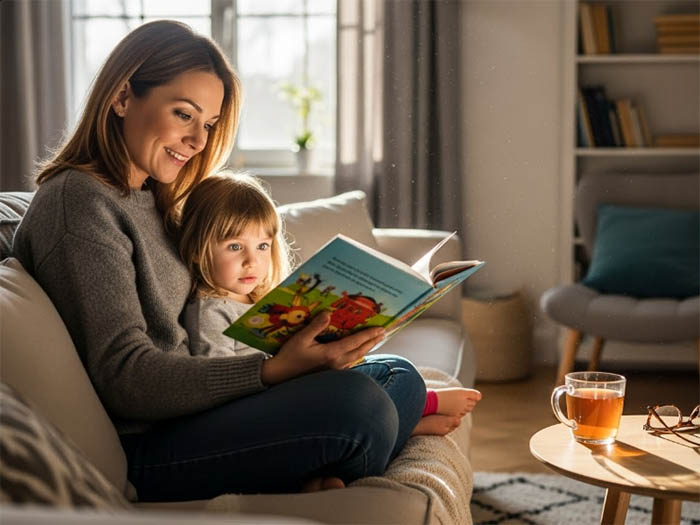
Reading is a powerful tool. Even 10 minutes a day will grow vocabulary and confidence fast.
Start with picture books, transition to easy chapter books, then tackle age-appropriate Korean readers. Libraries in Korea often have bilingual sections, and school libraries usually offer leveled readers.
Reading together also builds emotional closeness — and language stays tied to positive memories.
Celebrate Small Wins
Every child learns at their own pace. Celebrate:
- First full sentence in Korean
- Order at a snack shop
- Chat with a classmate
Small victories build confidence — and confident children use language more often.
Playgroups and Local Activities Help Big Time
Language skills aren’t built only in classrooms. Playdates, sports, community activities, and parent-child classes help children use Korean socially. Many foreign parents find that:
- Children learn more in play
- Kids laugh through mistakes
- Social language comes before textbook grammar
This is spoken language learning at its best.
Keep the Other Language Strong Too
Raising a bilingual child isn’t about replacing one language with another. Keep your home language strong as well. Research shows that children who feel secure in their first language often learn a second language more confidently.
Make room for both languages — not as competition, but as companions.
Be Patient With Plateaus
Language learning isn’t linear. Children often:
- Make quick progress at first
- Hit a quiet plateau
- Suddenly jump ahead again
This is normal. Praise effort, not just outcomes. Consistent exposure matters more than perfection.
Cultural Context Boosts Language Skills
Language isn’t a list of words. It’s culture in motion.
Take time to:
- Attend festivals
- Visit local markets
- Share stories of Korean holidays
When children understand culture, language becomes living language, not test language.
Parents Are the First Teachers
Your belief in your child’s ability matters. Children pick up on energy more than instruction. Encouragement like:
- “I like how you said that in Korean!”
- “Can you teach me that word?”
- “You’re improving every day!”
keeps motivation alive.
Final Thought: Language, Confidence, and Belonging
Helping your child learn Korean as a second language isn’t a one-week project. It’s a lifetime gift that opens doors socially, academically, and emotionally. Children raised in Korea with strong Korean language skills have more confidence, more friendships, and more chances to enjoy life here fully.
And remember laughter, curiosity, and everyday moments are some of the best language teachers there are.