
Is Factory Work in Korea Physically Demanding? A Local’s Real Answer
Factory jobs come in all shapes and sizes, and in Korea — a country known for its robust manufacturing sector — many people ask the same practical question: Is factory work physically demanding? The short answer is yes … but how demanding it feels depends on the industry, your role, your fitness level, and your expectations.
As a Korean local who has lived around manufacturing towns, heard countless stories from foreign workers, and chatted with families of factory employees, I want to give you a balanced, honest, and practical perspective that goes beyond stereotypes.
Understanding “Factory Work” in Korea
When people talk about factory work, they usually mean jobs in:
- Electronics assembly
- Automotive parts production
- Heavy machinery manufacturing
- Textile and apparel production
- Food processing
- Packaging and logistics
Each has a different rhythm, workload, and physical requirement. So let’s unpack this with real eye-level clarity.
Physical Demand: It Varies a Lot by Job Type
Light to Moderate Physical Work
Some factory jobs are less physically demanding:
- Monitoring automated lines
- Packing finished products
- Quality inspection
- Machine setup and basic operation
In these roles, you may stand or walk for several hours, but the exertion isn’t intense. Many positions are suitable for people who are in decent health but not used to heavy lifting.
Physically Demanding Roles
Other factory tasks can be quite physically demanding:
- Heavy lifting of parts or materials
- Operating equipment that requires manual effort
- Repetitive motion tasks (e.g., assembly line work)
- Bending, squatting, or prolonged standing
In these cases, good stamina and strength help a lot. These jobs are common in automotive, construction materials, and heavy manufacturing.
From a local perspective, the physical demand is often the biggest shock to newcomers who expected a “simple job.”
Typical Daily Rhythm on a Factory Floor
Korean factory shifts tend to be structured with clear routines:
- Morning assembly line briefing
- Regular work blocks (often 8 hours or more)
- Scheduled breaks and lunch
- Sometimes overnight or rotating shifts
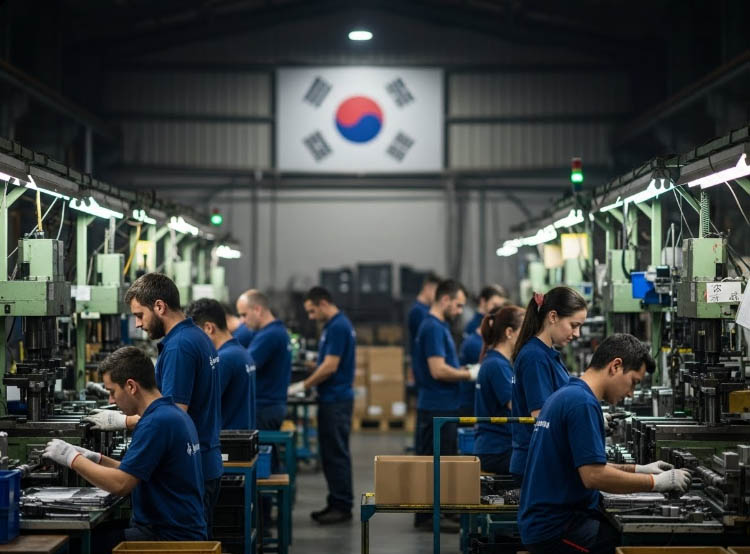
Standing for long periods is common. In more physical roles, you might:
- Walk several kilometers over a shift
- Lift boxes, parts, or crates
- Move between stations quickly
- Repeat the same motion hundreds of times
This kind of work rewards endurance as much as skill.
Are There Breaks and Pacing?
Yes — breaks are legally required. Most factories offer:
- A mid-morning break (10–15 minutes)
- A lunch break (30–60 minutes)
- A mid-afternoon break (10–15 minutes)
However, these short rest periods don’t fully offset long hours on your feet, so pacing yourself matters. Locals often recommend light stretching, changing posture frequently, and using breaks to recharge physically.
Language and Safety: Crucial for Physical Comfort
A big part of handling physical work safely is communication. Many factory sites in Korea operate in Korean, and safety briefings, equipment instructions, and warning signs are typically in Korean.
If your Korean is limited, it’s very helpful to:
- Learn basic safety terms
- Ask supervisors for clear demonstrations
- Watch how experienced coworkers handle equipment
Misunderstanding instructions can make physical tasks feel harder or risk injury, so early language learning pays off more than you might expect.
Comparing Korea to Other Countries
Foreigners who have worked both in Korea and abroad often comment on differences:
Higher Discipline, Structured Pace
Korean factories tend to emphasize consistent tempo and quality. You are expected to keep up with the line’s rhythm.
Team-Oriented Workflow
Work is a collective effort — slowing down affects others. This can feel physically intense if you are used to self-paced work.
Safety Standards
Korea has strict safety regulations, but actual practice varies by company. Bigger firms usually have formal safety protocols.
So while the effort might be similar to factories elsewhere, the pace and group expectations can make it feel more demanding especially at first.
Health and Fitness: What Helps Most
To handle physical factory work well in Korea, people generally benefit from:
- Good leg and core strength (for standing and lifting)
- Cardiovascular fitness (for constant movement)
- Flexibility (to reduce strain)
- Hydration and proper rest
Simple things like good shoes and ergonomic posture make a real difference over long shifts.
Common Misconceptions Foreign Workers Have
From talking with expats, these misunderstandings come up more than you might think:
“Factory jobs are easy physical jobs.”
Not always. Some are easy; others are demanding.
“I can learn it quickly and muscle through.”
Technique matters as much as strength.
“If I don’t speak Korean, it’ll be fine.”
Communication affects safety and comfort.
Once you understand the true nature of the work, you can decide whether it fits your strengths and goals.
Is Factory Work Worth It?
Many foreigners find factory jobs in Korea:
- A stable source of income
- A chance to build Korean work experience
- A stepping stone to other opportunities
- A way to integrate locally
Yes, it can be physically demanding — but it’s also structured, predictable, and often a gateway to long-term life in Korea.
Locals often say: physical work is hard anywhere; the key is whether you feel prepared, respected, and supported. In factories that value training and teamwork, the physical demand feels manageable and even rewarding over time.
Final Thoughts from a Korean Local
If you’re considering factory work in Korea, here’s the bottom line:
It can be physically demanding, but it’s not universally extreme.
Some roles are lighter and technical, others require endurance. The true challenge is often adapting to pace, communication style, and teamwork — not just physical strength.
Success in this environment comes from preparation: knowing what to expect, training your body and communication skills, and understanding how productivity and safety go hand in hand here.
Once you get into the rhythm, you’ll find that physical labor becomes less about strain and more about competence — and for many people, that’s a surprisingly satisfying place to be.