
Korean Marriage Culture Explained for Foreign Spouses
You’ve watched the K-Drama wedding—a beautiful white dress, a quick exchange of vows, and maybe a dramatic wrist-grab. But when you marry a Korean national, you are stepping into a rich, complex culture where marriage is less about the individual couple and more about the union of two families.
This cultural reality can be confusing, exciting, and sometimes challenging. As a local, I’m here to give you the essential playbook to understanding Korean marriage culture, from the expectations of in-laws to the real meaning behind the gifts.
Pillar 1: The Definition of Marriage (Family First)
Unlike individualistic Western views, Korean marriage is traditionally viewed through a Confucian lens, emphasizing hierarchy, duty, and the continuation of the family line.
1. You Marry the Family, Not Just the Person
The Reality: Your spouse’s parents remain highly influential. Their opinion matters in everything from where you live to how you raise your children.
Your Role: Showing consistent respect (using correct titles like Abeonim and Eomeonim for father and mother-in-law) and sincerity (showing effort, even if you make mistakes) is the fastest way to gain acceptance and build trust.
2. Financial Security is Love
Before the wedding, the biggest discussion is usually financial. Traditionally, the groom’s side handled the housing (Jeonse or Wolse deposit), and the bride’s side handled the furniture and gifts (Yedan).
The Modern Twist: While modern couples pool resources, the emphasis remains on starting the marriage with strong financial stability. This pragmatism is seen not as unromantic, but as a crucial act of love and responsibility toward the future family.
Pillar 2: The Wedding Ceremony (Speed and Efficiency)
The actual wedding ceremony can be a surprise for foreigners accustomed to long, elaborate rituals.
3. The 30-Minute Marathon
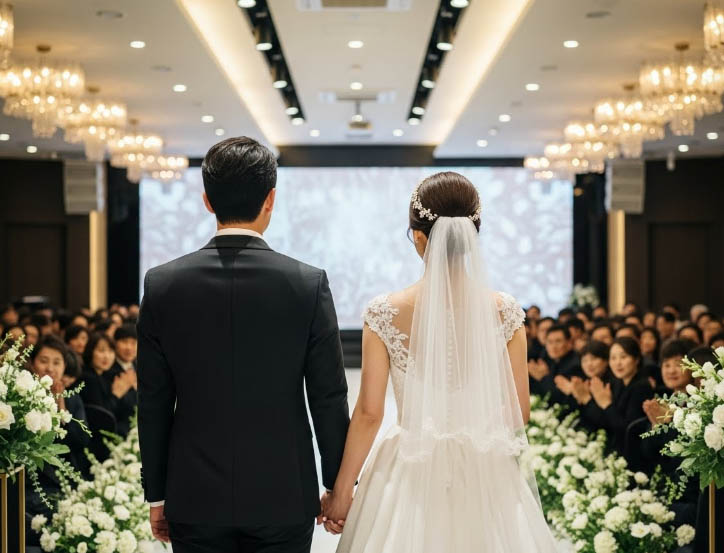
Traditional Korean weddings are famously quick and efficient, often lasting only 20–30 minutes. They are typically held in specialized wedding halls (Wed-ding Hall, 웨딩홀) and involve hundreds of guests who rotate quickly.
The Don’t: Don’t expect long speeches or a massive dance floor; the focus is on speed, efficiency, and a polite exchange of gratitude.
4. The Money Envelope (The Gift Culture)
Guests traditionally give cash gifts in white envelopes (Chuk-ui Geum, 축의금) upon arrival, and they may leave shortly after the meal. This cash helps the couple fund their start and offset the high wedding costs.
Your Role: If you invite your foreign family, ensure they understand that cash in an envelope is the standard and most appreciated gift.
Pillar 3: Post-Marriage Duty (The Calendar)
Married life comes with mandatory cultural obligations that define the rhythm of the year.
5. Ancestral Holidays (Seollal and Chuseok)
These major holidays are non-negotiable family duties. Traditionally, the wife travels to the husband’s family home to help prepare elaborate meals and ancestral rites (Jesa).
The Modern Compromise: Many modern couples now simplify the rituals or alternate between families, but the expectation to participate and honor the ancestors remains profound. Your commitment to these days is a measure of your commitment to the family.
6. The Relationship is Always “We”
The couple is referred to as Uri (우리—we, us). The individualistic “I” often takes a back seat to the collective “we.”
The Result: Your spouse’s life, schedule, and social standing are directly tied to yours. Embracing this sense of unity and shared fate is the core of a stable Korean marriage.