
The Foreigner’s Guide to Renting a Studio Apartment in Korea
You’ve landed the job or secured your student visa, and now the real quest begins: finding your own place in Korea. Forget casual month-to-month leases; the Korean rental market is unique, efficient, and dominated by two financial pillars: Key Money (Deposit) and the One-Room (원룸) studio apartment.
Navigating this system as a foreigner can feel like cracking a financial code. As a local, I’m here to demystify the process, explain the key financial terms, and give you the essential steps to secure your perfect one-room without getting ripped off.
Pillar 1: Understanding the Financial Structure
Forget first month’s rent and a small security deposit. Korea uses two main systems, both requiring significant upfront capital.
1. Wolse (월세): The Monthly Rent System
The Structure: This is the most common system for foreigners. You pay a large, refundable security deposit (the Key Money) upfront, and then a set amount of monthly rent.
The Cost: Expect the Key Money deposit to be anywhere from ₩5,000,000 to ₩20,000,000 KRW (approx. $3,800 to $15,000 USD). The monthly rent is lower than in the West because the deposit acts as collateral.
The Benefit: This is easier on your immediate monthly budget than the next option.
2. Jeonse (전세): The Massive Deposit System
The Structure: You pay a huge lump sum deposit (often 50% to 80% of the property’s value) to the landlord. You pay zero monthly rent. The landlord earns money by collecting interest on your deposit.
The Reality: While financially appealing in the long run (you get your full deposit back!), this system is generally unrealistic for short-term expats or students due to the immense upfront capital required.
Local Tip: When calculating your budget, remember the monthly Wolse rent often does not include utilities (electricity, gas, water, internet/management fee). Factor in an extra ₩100,000 – ₩200,000 KRW per month for these necessities.
Pillar 2: The Apartment Types (Finding Your One-Room)
When you ask a realtor for a studio, you’ll likely be offered one of these two types.
1. One-Room (원룸)
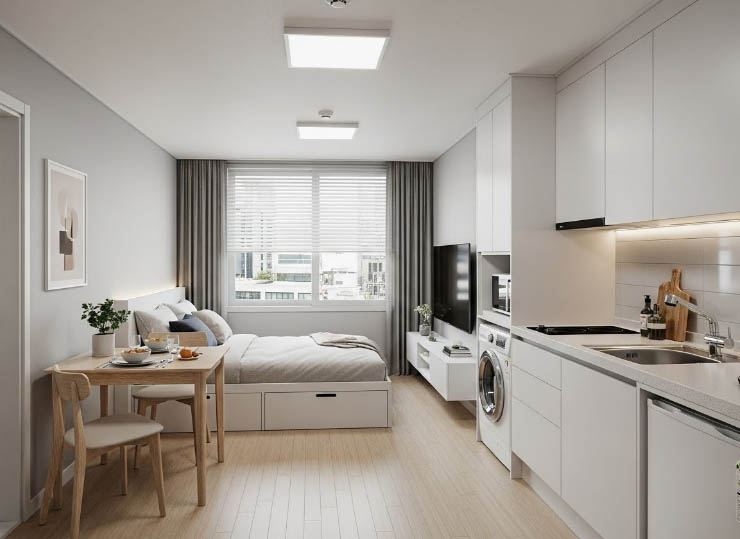
The Vibe: The classic studio. A single, combined living/sleeping/kitchen area with a separate bathroom. Usually small (16–25 square meters) but efficient.
The Location: Found everywhere, often in dedicated residential buildings near universities or commercial areas.
2. Officetel (오피스텔)
The Vibe: A higher-end, multi-purpose unit designed for both living and a small office. They are usually newer, slightly larger, have better security, and sometimes offer basic amenities (gym, lobby).
The Cost: More expensive for both the Key Money deposit and the monthly Wolse rent, but you pay for convenience and quality.
Pillar 3: The Foreigner’s Action Plan (How to Sign the Lease)
You can’t do this alone. You need to follow these steps precisely.
1. Find a Real Estate Agent (Budongsan, 부동산)
Action: Go to a real estate office (Budongsan) in the neighborhood you want to live in. They are everywhere! Walk in and say, “Wolse One-Room Chaj-go isseoyo” (월세 원룸 찾고 있어요 – I’m looking for a monthly rent one-room).
Why it Works: They have the localized listings and, critically, they are legally required to manage the contract and deposit process safely.
2. Prepare Your Documents
You will need your passport, your Alien Registration Card (ARC) (or visa details if you haven’t received the ARC yet), and the deposit money ready.
3. The Contract (Get it Checked!)
Action: Never sign a lease you don’t fully understand. Bring a Korean friend, a co-worker, or hire a translator to review the contract (especially the clauses regarding utilities, repairs, and the deposit return).
The Crucial Step: Once the contract is signed, you must immediately take it to your local Dong or Gu Office to have it date-certified (Hwakjeong Ilja, 확정일자). This legally protects your deposit in case the landlord defaults.
Follow this plan, and you’ll smoothly transition from temporary housing to your own comfortable Korean home!